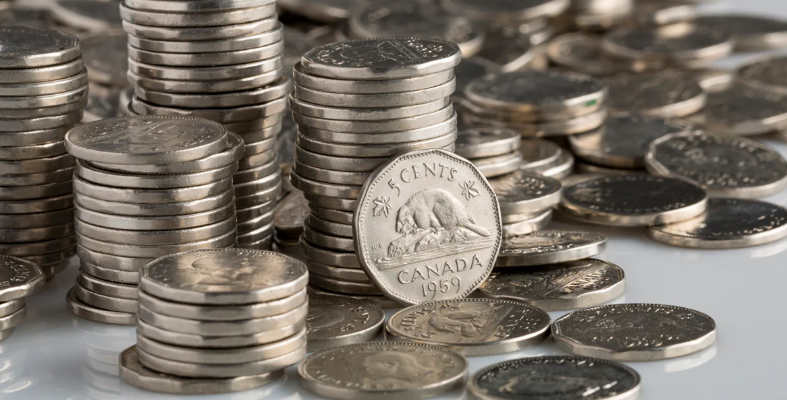
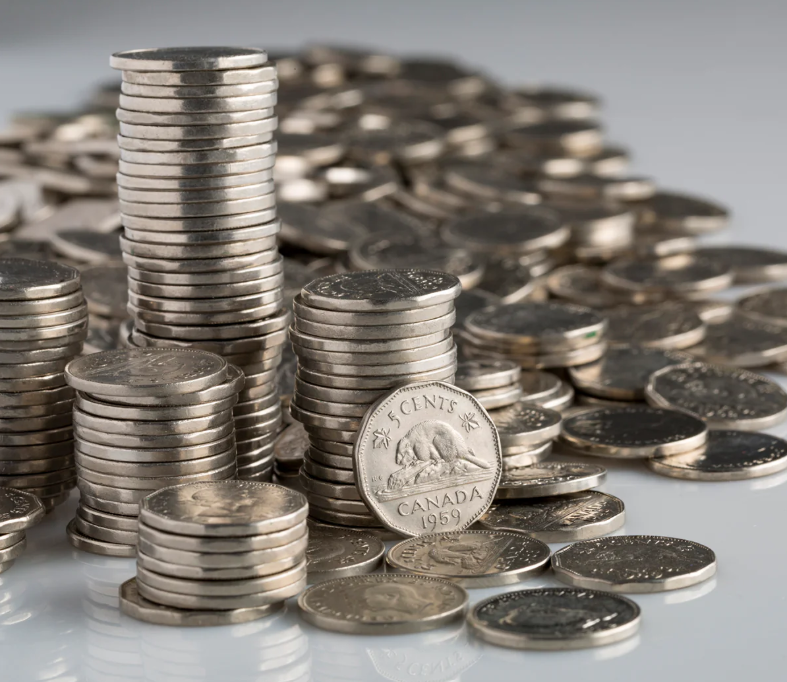
Those walking around with change in their pockets most likely have a few nickels in their collection. The thumb-sized, silver-looking coin portraying one of Canada’s beloved animals – the beautiful and majestic beaver – on the front. Contrary to its name, the Canadian nickel actually contains very little of its base metal namesake but is now made up of nickel-plated steel.
The history of how the 5-cent piece went from being made of silver to steel is a long and fascinating story.
Pre-Confederation Currency
Before Canadian Confederation in 1867, various British North American colonies (such as the Province of Canada, New Brunswick, and Nova Scotia) issued their own decimal currencies. In 1858, England’s Royal Mint rolled out coins meant specifically for the Province of Canada. The 5-cent coin was tiny, as its size was meant to reflect its value; half of a ten-cent coin. It was also made of sterling silver.
Standardization and the Dawn of Nickel (1870-1921)
After Confederation, the new Dominion of Canada began standardizing its currency. Up until then, Canada’s coins had continued to be produced by either England’s Royal Mint or the Birmingham Heaton Mint – noted by the “H” mint mark – until 1908 when the Royal Mint opened its branch in Ottawa.
The shift to the material that gives the coin its popular name came in 1922. Due to the rising cost of silver, and the metal shortages caused by the war, the Royal Canadian Mint (RCM) looked to reduce the production costs of the nickel. By this point, the coin’s economic role was too significant to get rid of completely, but a change in its make-up needed to be made in order to lessen the financial load.
In 1920, the RCM first began making the 5-cent coins out of lower quality silver, but just two years later, on January 3, 1922, the Canadian nickel was born. This version was made out of pure nickel and modelled after its American counterpart. Unlike the American nickel – which was 75% copper and only 25% nickel – Canada’s pure nickel coin meant that Canada had officially become the metal’s largest producer!
Wartime Changes and Design Explorations
World War II brought unprecedented material demands, forcing the Mint to look for alternatives to pure nickel, a metal essential for the war effort. Materials used for manufacturing the beloved coins were now diverted to armour production. In response, the nickel’s make-up went through a few changes to reflect what was readily available and cost-efficient.
- 1942–1943 : tombac, a bronze alloy made up of 88% copper and 12% zinc, which gave the coins a yellowish hue
- 1944–1945: chrome-plated steel
- 1946–1951: 99.9% nickel
- 1951–1954: chrome plated steel
- 1955–1981: 99.9% nickel
- 1981–1999: 75% copper, 25 % nickel
- 2000–present: 94.5% steel, 3.5% copper, 2% nickel plating
While the material production of the nickel was changing and evolving, so too was the design. Up until 1921, the coin had been recognized not only by its small size but by the crossed maple bough design on its surface. Then, from 1922 to 1936, the larger version of the nickel was changed to have two maple leaves instead. These remained until 1937 when the iconic Canadian mammal we’ve come to know and love – the beaver – first appeared.
While the beaver is still cast today, the nickel has had some notable commemorative changes on its reverse side:
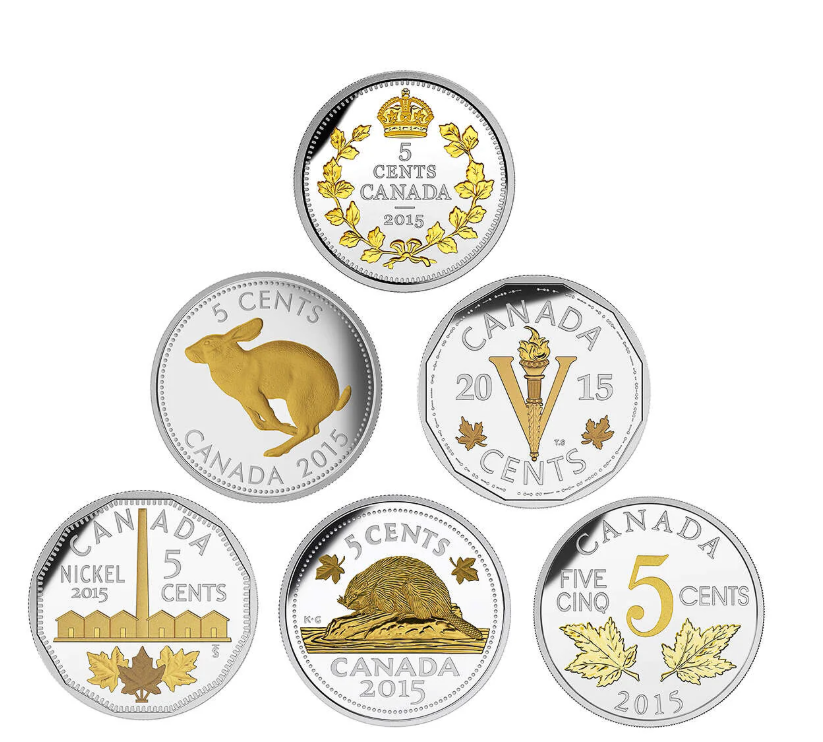
- 1942–1963: Nickels were dodecagonal, or 12-sided, in order to help distinguish them from the one-cent piece when they began to tarnish during circulation.
- 1943–1945: “We Win When We Work Willingly” was engraved in Morse code along the rim of the coin to promote the industrial effort during WW II. These nickels also featured a “V” (for victory) and a flaming torch (for sacrifice).
- 1967: To commemorate the 100th anniversary of Canadian Confederation, Alex Colville designed a special set for all coin denominations in circulation. The nickel featured a hopping hare.
- 2005: Marking the 60th anniversary of the end of the second World War, nickels brought back the 1943 design featuring the flaming torch, large V and surrounding Morse code.
- 2017: As a celebration of the 150th anniversary of Confederation, nickels showcased a design by Gerald Gloade of the Millbrook First Nation. Gloade’s design features the iconic beaver reimagined in the traditional artistic style of the Algonkian; a rendering that made Gloade one of five winners of the “My Canada, My Inspiration” contest.
The Canadian nickel is more than just five cents; it’s a tiny piece of metal history, marking Canada’s wartime sacrifices, industrial shifts, and beloved national symbols like the beaver.
Photos Courtesy of Canadian Coin & Currency